Is your child ready for Grade R?
R250,00
Is Your Child Ready for Grade R? Starting Grade R is an exciting milestone, but school readiness is about much more than knowing letters, numbers and colours. A child needs a combination of physical, cognitive, language, perceptual, emotional and social skills to cope confidently with the demands of the classroom. Every child develops at their own pace. The goal is not perfection. The goal is to make sure that the foundations needed for learning are developing strongly. Cognitive Skills Before formal learning can take place, a child needs to be able to think, remember, compare, organise and solve simple problems.…
Is Your Child Ready for Grade R?
Starting Grade R is an exciting milestone, but school readiness is about much more than knowing letters, numbers and colours.
A child needs a combination of physical, cognitive, language, perceptual, emotional and social skills to cope confidently with the demands of the classroom.
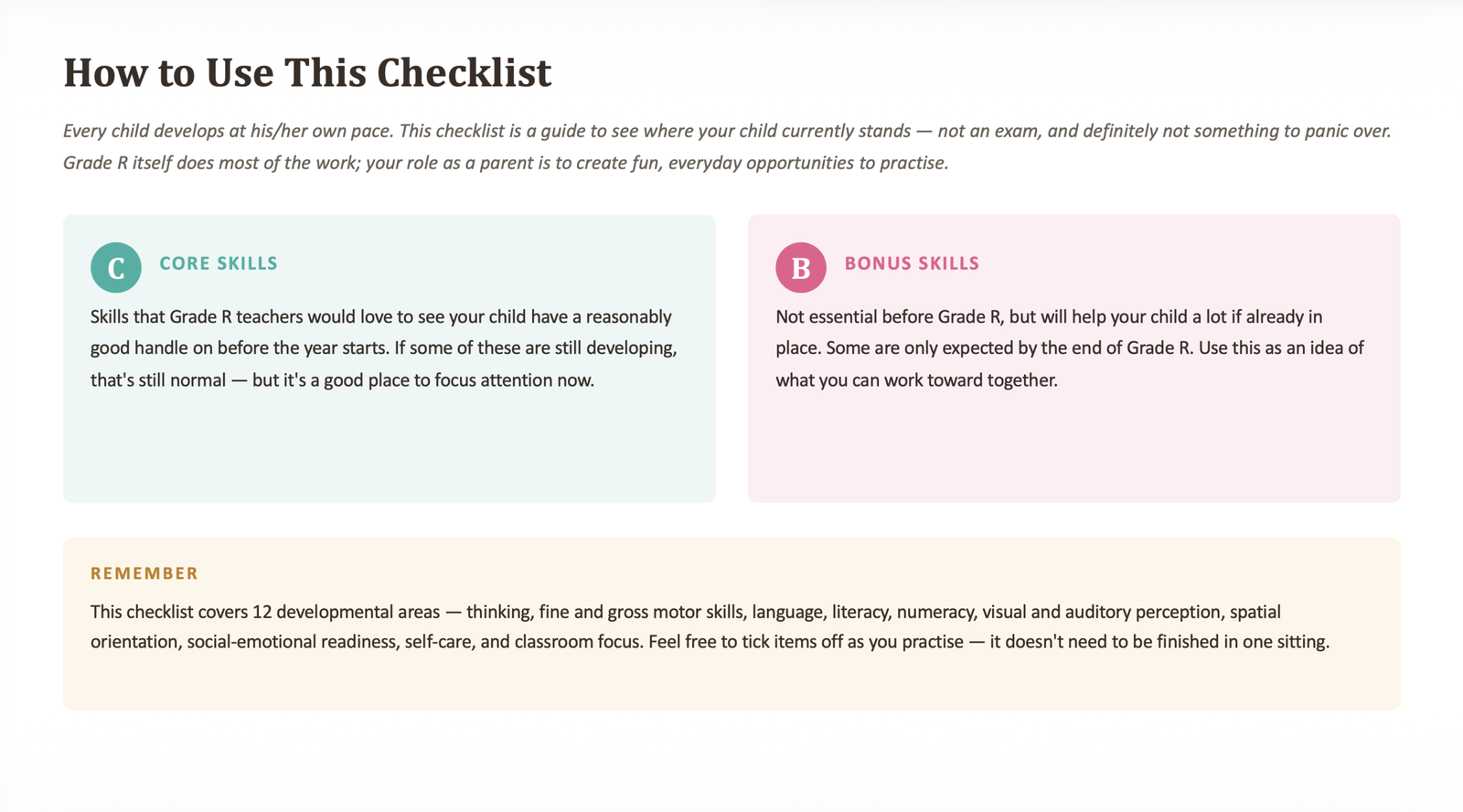
Every child develops at their own pace. The goal is not perfection. The goal is to make sure that the foundations needed for learning are developing strongly.
Cognitive Skills
Before formal learning can take place, a child needs to be able to think, remember, compare, organise and solve simple problems.
Important cognitive skills include:
Following simple instructions
Completing age-appropriate puzzles
Matching and sorting objects
Recognizing similarities and differences
Understanding simple patterns
Remembering information
Completing an activity from beginning to end
Finding simple solutions to problems
These skills help children make sense of what they see, hear and experience in the classroom.
Fine Motor Skills
Strong hands and fingers are essential long before a child is expected to write neatly.
A Grade R child should gradually be developing the ability to:
Hold crayons and pencils with increasing control
Draw basic shapes and pictures
Colour within an area
Use scissors
Thread beads
Build with small objects
Manipulate playdough
Open containers and use everyday classroom equipment
Fine motor development lays the foundation for handwriting, cutting, drawing and other classroom tasks.
Gross Motor Skills
Children learn with their whole bodies.
Running, jumping, climbing, balancing, throwing and catching all help develop body awareness, coordination, posture and core strength.
These skills also support a child’s ability to sit at a desk, control their body, cross the midline and participate confidently in classroom activities.
Language and Communication
Language is one of the most important foundations for learning.
A child entering Grade R should be developing the ability to:
Speak in understandable sentences
Express needs and ideas
Answer simple questions
Tell a basic story or explain what happened
Understand age-appropriate vocabulary
Listen while someone else is speaking
Follow verbal instructions
Take turns in conversation
Strong language skills later support reading, spelling, comprehension and written language.
Emergent Literacy
Children do not need to be fluent readers before entering Grade R.
They do, however, benefit from strong early literacy foundations.
These may include:
Enjoying books and stories
Knowing that print carries meaning
Recognising their own name
Becoming aware of letters
Hearing rhyming words
Identifying sounds in words
Breaking words into parts or syllables
Listening for beginning sounds
Developing an interest in drawing and early writing
Before children can read words successfully, their brains first need to become aware of the sounds inside spoken language.
Emergent Mathematics
Early maths is much more than counting.
Children need opportunities to develop an understanding of:
Number concepts
Counting objects accurately
More and less
Big and small
Long and short
Shapes
Patterns
Sorting and grouping
Position
Sequence
Simple problem-solving
These early concepts create the foundation for later mathematical understanding.
Visual Perception
A child needs to be able to make sense of what the eyes see.
Visual perceptual skills help children:
Notice differences between shapes, letters and numbers
Find an object among other objects
Remember what they have seen
Recognise patterns
Copy shapes
Complete puzzles
Follow information from left to right
These skills later become important for reading, spelling, handwriting and mathematics.
Auditory Perception
Children also need to make sense of what they hear.
Auditory perceptual skills include:
Listening carefully
Hearing differences between sounds
Remembering spoken information
Following instructions
Recognising rhyming words
Hearing sounds within words
Repeating sequences in the correct order
These abilities are particularly important when children begin learning letter sounds, blending and reading.
Spatial Orientation
Children need to understand where their bodies and objects are positioned in space.
Concepts such as:
Above and below
In front and behind
Next to
Between
Inside and outside
Left and right
form part of spatial development.
Good spatial orientation later supports letter formation, directionality, mathematics and reading from left to right.
Social and Emotional Readiness
Being ready for school also means being able to function as part of a group.
A child should gradually learn to:
Separate from a parent or caregiver
Play alongside and with other children
Take turns
Share
Wait for short periods
Ask for help
Cope with small disappointments
Follow classroom boundaries
Begin managing emotions appropriately
Children do not need to manage every emotion perfectly. They are still learning.
What matters is that these skills are developing.
Independence and Self-Care
Grade R gives children many opportunities to become more independent.
Useful skills include:
Going to the toilet independently
Washing and drying hands
Eating and drinking without constant assistance
Opening a lunchbox
Packing away belongings
Putting on or removing simple clothing
Looking after personal belongings
Completing small tasks independently
Every small act of independence builds confidence.
Executive Functions
Executive functions are the brain’s management system.
They help children:
Pay attention
Remember what they need to do
Follow steps in the correct order
Control impulses
Move from one activity to another
Start and complete a task
Persist when something is difficult
Organise themselves
These skills play a major role in how successfully a child manages everyday classroom demands.
Understanding School Routine
A child also needs time to adjust to the rhythm of school.
This includes learning to:
Sit and listen for age-appropriate periods
Follow a classroom routine
Move between activities
Pack away
Work independently for short periods
Participate in group activities
Follow instructions from a teacher
Understand that there is a time for playing, listening, working and resting
Routine gives young children predictability and security.
School Readiness Does Not Mean Perfection
A child does not need to tick every box before entering Grade R.
Children develop at different rates, and some areas may be stronger than others.
What we are looking for is a growing foundation from which the child can learn.
When a child is struggling in several of these areas, early support can make an enormous difference.
The earlier we strengthen the foundations, the less effort the child may need to use later simply to keep up.
At Micci Teaches, I focus on building the underlying skills children need for successful learning through movement, play and multisensory activities.
Because before we expect a child to read, write and calculate, we first need to make sure the brain and body are ready to learn.
Related products
-
Auditory & Visual Processing Skills Program
Original price was: R1 750,00.R1 500,00Current price is: R1 500,00.